
Do Nonprofits Still Need a CRM in the Age of AI?
“If AI is getting this good… do we even need a CRM anymore?” It’s a fair question, everyone seems to be asking it, and honestly, it’s not a crazy one. I’ll admit, it’s something I’ve been thinking about quite a bit, too. Given that most new CRM solutions are in place for 10 years or more, it also becomes a mission-critical question.

I’ve spent over 30 years defining nonprofit system requirements, designing systems and processes, and thinking through how technology supports real-world operations. More recently, I’ve even started using tools like OpenAI Codex to build lightweight applications myself, which makes the pace of change feel even more real.
So I’ve spent some time stepping back and really thinking about this question—and where things are headed—and how a CRM should be thought of in the context of AI, vibe coding, and tools like Claude.
Let's dive in by considering what a CRM is really responsible for.
Why This Question Keeps Coming Up
AI is moving fast—faster than most of us expected. Today, someone can “vibe code” an application in a day and have it live by the end of the week.
But speed and flexibility aren’t the same as governance and reliability.
Nonprofits need systems that are structured, governed, and auditable—because the data behind them drives real decisions, real reporting, and real accountability.
And those systems need to last. People leave organizations. Teams change. Systems need to be maintained, supported, and updated over time.
From a nonprofit perspective, today’s tools can:
Summarize donor histories in seconds
Recommend next best actions
Identify patterns across massive datasets
Help structure messy information
Vertically integrate payments and process ACH and credit cards seamlessly
More importantly, CRM systems come with an ecosystem that includes partner applications, integration capabilities, enterprise-grade security, and the infrastructure required to support them.
With all of AI's lure, it’s natural to start thinking:
What if we just store all our data somewhere and let AI figure it out?
What if I vibe-coded a CRM?
What if I just use a data warehouse or a modern data platform?
Simple. Flexible. No rigid systems. The world is full of opportunity.
But also, no constraints. No structure. No governance. No Security.
It may sound appealing to organizations that have felt constrained by traditional systems, but is it really? Constraints and guardrails exist for good reasons, and flexibility often leads to broken systems with data structures that are difficult to manage and even harder to trust.
A CRM Is Not Just a Database
A CRM is often described as a “database,” but that’s like calling a hospital an “office building.”
Technically true. Completely misses the nuance.
A modern nonprofit CRM is:
A system that provides structured data - and a system of record
A data governance engine
A process enforcer
A shared definition of how your organization understands donors, gifts, and relationships
An automation engine
Put more simply:
A CRM doesn’t just store your data; it defines what your data means, how it’s used, and, more importantly, right now, how it’s trusted. Modern CRM’s are secure and ensure regulatory compliance.
These distinctions really matter.
Because AI can interpret data, but it does not inherently:
Enforce standards
Prevent inconsistency
Apply business rules
Maintain auditability
Those are not small things. In nonprofit organizations, donor trust is foundational and far more critical than in the commercial world. Nonprofit ‘customers’ or donors don’t have anything to lose by terminating their support for a charity, unlike a business relationship, where stopping means losing access to something like a gym membership, a morning coffee, or a streaming service.
I’d actually argue that for nonprofits, CRMs are more critical than ever. AI doesn’t just need to be impactful—it needs to be responsible.
And to do that, it needs data that is:
Structured
Consistent
Governed
Trusted
Complete
Connected (across people, gifts, and relationships)
Maintained over time
The Part We Don’t Talk About Enough: Data Governance
This is the piece that tends to get overlooked in the AI conversation, yet is essential to impactful AI data governance. Data governance isn’t glamorous, but it’s what makes everything else possible.
A well-implemented CRM does things that are easy to take for granted:
Standardizes how data is captured (What qualifies as a constituent? A household? An organization?)
Enforces consistent definitions (What counts as a gift vs. a pledge vs. a soft credit?)
Maintains relationships over time (Individuals, households, corporate affiliations, historical connections)
Controls data quality at the point of entry (Required fields, validation rules, deduplication processes)
Provides auditability and compliance (Who changed what, when, and why)
Ensures regulatory and security compliance (Access controls, encryption, data privacy, and security standards)
Without this layer, you don’t have a reliable dataset; you have a collection of inputs.
And that distinction becomes critical when AI enters the picture.
The Risk: AI + Messy Data = Bigger Mess
There’s an assumption embedded in a lot of AI conversations:
That AI will somehow fix inconsistent or incomplete data, or overall just solve problems.
This is fundamentally wrong. AI is only as good as its data sources. Despite AI improving quickly, it will never be infallible; it still hallucinates and often makes things up because it thinks it is reading ‘facts’ when it’s actually reading unstructured data.
Just last night, AI confidently gave me incorrect information about how our HubSpot system should work. It was pretty spot on, until it wasn’t. I had to ask a few times before it admitted it was wrong and then finally gave me the right information - which is a good reminder that confidence and accuracy aren’t the same thing.
AI will take whatever quality of data you have and apply those patterns and conclusions broadly, quickly, and repeatedly across many decisions. For example:
Duplicate donor records → AI recommends outreach based on fragmented history
Inconsistent coding → AI misinterprets donor value or engagement
Missing relationships → AI overlooks key connections and networks
AI doesn’t fix bad data. It accelerates whatever is already there - good or bad.
If your data is strong, AI becomes powerful.
If your data is inconsistent, AI becomes unpredictable.
Reframing the Conversation: CRM + AI
This is where I think the conversation needs to shift.
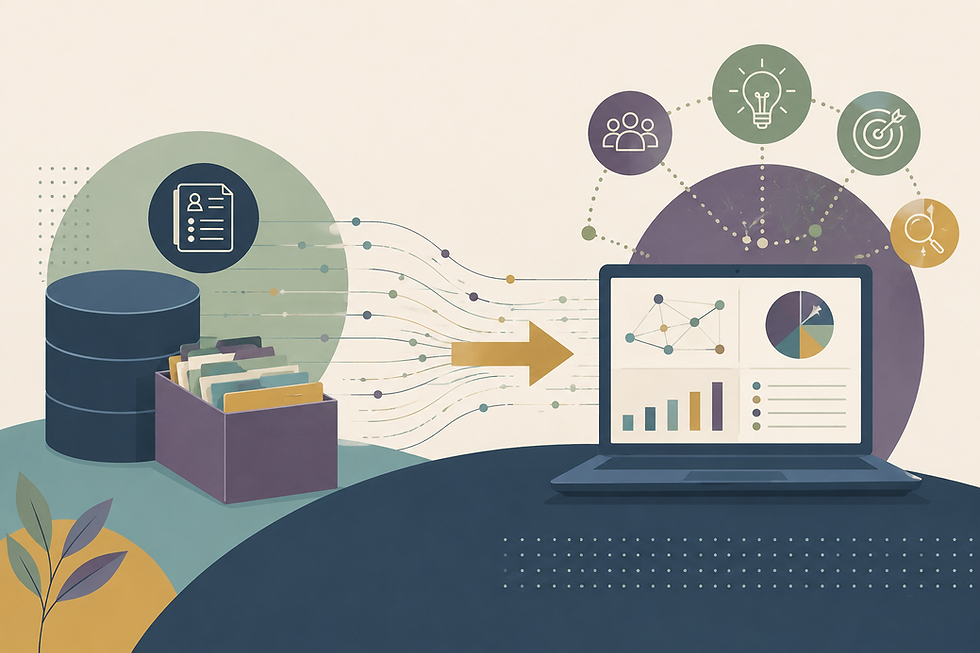
This isn’t really a CRM vs AI debate. It’s really a conversation about a systems-of-record vs systems-of-intelligence.
Both matter—and they serve very different roles.
CRM | AI |
System of record | System of intelligence |
Enforces structure | Interprets patterns |
Maintains data integrity | Generates insights |
Supports governance and compliance Controls security/privacy | Recommends actions Respects privacy |
And currently, AI is not a replacement for CRM. It’s an amplifier or a catalyst that can only work if it has a structure to support it. If it doesn’t, chaos will ensue.
AI is only as effective as the system it’s standing on. And right now, that system is still - and will be for quite a while - your CRM. And not just any CRM – a structured, industry-specific, and data control-focused one.
Without a structured foundation, AI doesn’t become more innovative—it becomes more speculative and more likely to act irresponsibly.
What Will Actually Change
The role of CRM is not disappearing, but it is evolving and will continue to.
I think we’re moving into a model where:
Data entry becomes more automated as a source
Workflows become more intelligent and adaptive
Insights are surfaced proactively instead of being reported retroactively
Users spend less time navigating systems and more time acting on recommendations
The expectation is shifting from:
“Track and report what happened” to: “Help me understand what to do next.”
That shift is being driven by AI—but it depends entirely on having a reliable system underneath it.
So… Will We Still Need CRMs?
For now, yes. But the expectations are changing.
Technology is evolving quickly, and yes, there may come a time when CRM looks very different from what it does today. But even then, the data, and how it’s structured and managed, will remain critical.
But that day is not today, and in my opinion, it’s not in the next 5. A lot of work needs to be done to get nonprofits to that point.
For now, I believe we’re moving toward a world where:
A CRM without AI will feel incomplete
And AI without a CRM will feel unreliable
If you think AI means you don’t need a CRM anymore, you’re underestimating the importance of structured, trusted data. The organizations that succeed in this next phase won’t be the ones that move away from systems of record. They’ll be the ones that strengthen them and then layer intelligence on top.

Comments